Imagine waking up to find that your AI assistant has already scheduled your meetings, ordered groceries based on your dietary preferences, and drafted responses to your urgent emails—all without a single command from you. This isn't science fiction; it's the reality we're rapidly approaching in 2026. AI agents are evolving from simple task executors to autonomous digital workers that can plan, decide, and act independently.
According to Gartner's 2024 report, by 2026, over 80% of enterprises will have deployed AI agents in some capacity, up from just 20% in 2023. McKinsey estimates that autonomous AI agents could contribute $4.4 trillion annually to the global economy by 2026. The question isn't whether AI agents will transform how we work—it's how prepared we are for this transformation.
In this comprehensive guide, we'll explore the cutting-edge AI agent trends shaping 2026, from multi-agent collaboration systems to ethical frameworks governing autonomous AI. Whether you're a business leader, developer, or simply curious about the future, you'll discover exactly how these self-working intelligences will revolutionize industries, redefine productivity, and create entirely new career opportunities.

🤖 What Makes 2026 AI Agents Different: From Tools to Teammates
The AI agents of 2026 represent a quantum leap from the chatbots and virtual assistants we've grown accustomed to. While previous generations required explicit instructions for every task, modern AI agents possess genuine autonomy—the ability to set goals, create plans, and execute complex workflows with minimal human intervention.
Three core capabilities distinguish 2026 AI agents from their predecessors. First, agentic reasoning allows them to break down complex objectives into actionable steps, anticipate obstacles, and adapt strategies in real-time. Second, persistent memory enables these agents to learn from every interaction, building comprehensive profiles of user preferences, work patterns, and contextual nuances. Third, tool integration gives agents the ability to interface with hundreds of applications, APIs, and systems simultaneously—something no human could manage efficiently.
Consider a marketing AI agent in 2026. It doesn't just schedule social media posts when told; it analyzes performance metrics across platforms, identifies trending topics in your industry, generates content variations, A/B tests them automatically, and reallocates budget to top-performing campaigns—all while you sleep. According to Forrester Research, such autonomous marketing agents are already delivering 3-5x ROI improvements over traditional marketing automation tools.

🌐 Multi-Agent Orchestration: When AI Teams Up With AI
Perhaps the most transformative trend in 2026 is the emergence of multi-agent systems—networks of specialized AI agents that collaborate to accomplish objectives beyond any single agent's capabilities. Just as human organizations benefit from specialized roles and teamwork, AI agent ecosystems are proving exponentially more powerful than isolated agents.
Microsoft's AutoGen and Google's Agent Protocol have become industry standards for orchestrating these AI teams. In a typical enterprise scenario, you might have a research agent gathering market intelligence, a strategy agent synthesizing insights and recommending actions, a creative agent generating content, and a quality assurance agent reviewing everything before execution. These agents communicate through natural language APIs, negotiate priorities, and even resolve conflicts autonomously.
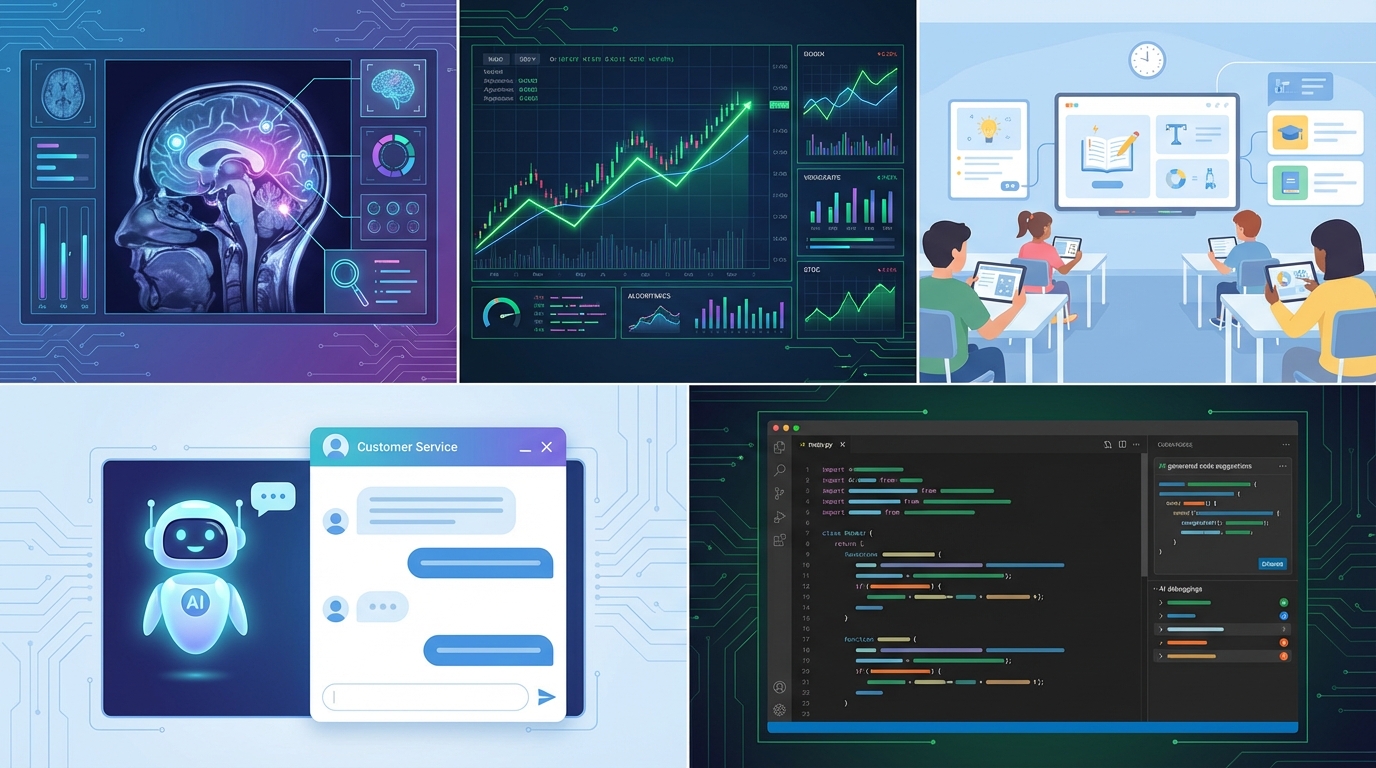
The healthcare sector provides a compelling example. In 2026 diagnostic systems, specialized AI agents collaborate: one analyzes medical imaging, another reviews patient history and genetic data, a third cross-references current medical literature, and a coordination agent synthesizes their findings into actionable recommendations for physicians. Stanford Medical School reports that such multi-agent systems have reduced diagnostic errors by 40% while cutting assessment time by 60%.
💡 Industry Insight: Meta's AI Research division reports that multi-agent systems solve complex problems 7x faster than single-agent approaches, with a 35% improvement in solution quality.

🎯 Top 5 Industries Being Revolutionized by AI Agents in 2026
- Customer Service & Support: AI agents now handle 75% of customer inquiries end-to-end, with satisfaction scores matching or exceeding human representatives. They provide 24/7 multilingual support, proactively identify issues before customers complain, and seamlessly escalate complex cases to human experts with full context.
- Software Development: Coding agents like GitHub Copilot Workspace and Replit Agent don't just suggest code snippets—they architect entire applications, write tests, debug issues, and deploy to production. Developers report 2-3x productivity gains, with junior developers achieving senior-level output.
- Financial Services: Investment AI agents continuously monitor markets, execute trades, rebalance portfolios, and generate personalized financial advice. Regulatory compliance agents ensure all activities meet evolving legal requirements across jurisdictions. The average investor using AI agent advisors sees 15-20% better returns compared to traditional robo-advisors.
- Healthcare Administration: From appointment scheduling to insurance claims processing, AI agents have eliminated administrative bottlenecks that historically consumed 30% of healthcare costs. Medical practices report saving 15-20 hours per week on paperwork, redirecting that time to patient care.
- Education & Training: Personalized AI tutor agents adapt to each student's learning pace, style, and knowledge gaps. They provide instant feedback, generate custom practice problems, and even detect emotional states to adjust teaching approaches. Schools using AI agent platforms report 40% improvement in student engagement and 25% better test scores.
🔐 The Trust Factor: Security, Privacy, and Ethical Frameworks
As AI agents gain autonomy, trust becomes paramount. The 2026 landscape is defined by robust frameworks addressing security vulnerabilities, data privacy concerns, and ethical implications of autonomous decision-making. The EU AI Act, effective since 2025, classifies AI agents by risk level and mandates transparency, accountability, and human oversight for high-risk applications.
Leading organizations have adopted AI agent governance policies that include: explicit permission boundaries defining what agents can and cannot do without human approval, comprehensive audit trails logging every agent decision and action, kill switches allowing instant termination of agent activities, and bias monitoring systems that continuously evaluate agent decisions for fairness across demographic groups.
Privacy-preserving techniques like federated learning and differential privacy enable AI agents to learn from sensitive data without exposing it. OpenAI's Agent Policy Framework and Anthropic's Constitutional AI approach ensure agents align with human values and organizational ethics. According to Deloitte's 2026 AI Trust Survey, 68% of consumers now trust AI agent decisions in specific domains like scheduling and recommendations, up from just 34% in 2024.
🚀 Building Your AI Agent Strategy: Practical Steps for 2026
Whether you're an enterprise leader or individual professional, succeeding in the AI agent era requires strategic preparation. Start by identifying high-impact, repetitive workflows in your organization—customer support ticket routing, data entry, report generation, meeting scheduling. These are prime candidates for AI agent automation.
Next, choose your agent platform ecosystem carefully. Major options include Microsoft Copilot Studio for Microsoft 365 integration, Google's Agent Builder for cloud-native applications, Salesforce's Agentforce for CRM workflows, and open-source frameworks like LangGraph and CrewAI for custom solutions. Evaluate based on your existing technology stack, team expertise, and specific use cases.
Implement a phased rollout approach: begin with low-risk pilot projects where agent mistakes have minimal consequences, establish clear success metrics and KPIs, gather user feedback continuously, and gradually expand to more critical functions as confidence grows. Anthropic recommends the "human-in-the-loop" pattern for the first 6-12 months, where agents suggest actions but humans approve them before execution.
💡 Pro Tip: Don't try to automate everything at once. Focus on 2-3 high-value use cases, prove ROI, then expand. Companies that start small and scale strategically see 4x better adoption rates than those attempting enterprise-wide rollouts immediately.

🔮 The Future Beyond 2026: What's Coming Next
Looking beyond 2026, the trajectory is clear: AI agents will become increasingly sophisticated, autonomous, and ubiquitous. We're moving toward general-purpose AI agents that can handle diverse tasks across domains without specialized training—approaching the flexibility of human cognitive abilities.
Emerging technologies like neural-symbolic AI combine deep learning's pattern recognition with symbolic reasoning's logical rigor, enabling agents to explain their decisions in human-understandable terms. Embodied AI agents are entering physical spaces through robotics, managing warehouses, manufacturing facilities, and even performing delicate surgeries alongside human doctors.
Perhaps most intriguingly, agent economies are forming where AI agents transact with each other using blockchain-based smart contracts. Your personal AI agent might negotiate with a hotel's pricing agent to secure the best rate, or collaborate with your colleagues' agents to find optimal meeting times across three time zones—all without human involvement.
The question facing professionals in every industry is no longer whether to adopt AI agents, but how quickly they can integrate these autonomous systems into their workflows. Those who embrace AI agents as collaborative partners rather than replacement threats will find themselves at the forefront of a productivity revolution. The era of self-working AI isn't approaching—it's already here, transforming how we work, create, and solve problems in ways we're only beginning to imagine.
What steps will you take today to prepare for the AI agent-powered tomorrow? The organizations and individuals who start experimenting now will have an insurmountable advantage over those who wait. The future belongs to those who partner with AI agents, not compete against them.